[00:01] Justin Baeder:
Welcome to Principal Center Radio, bringing you the best in professional practice.
[00:06] Announcer:
Here's your host, Director of the Principal Center and Champion of High Performance Instructional Leadership, Dustin Baver. Welcome everyone to Principal Center Radio.
[00:15] Regie Routman:
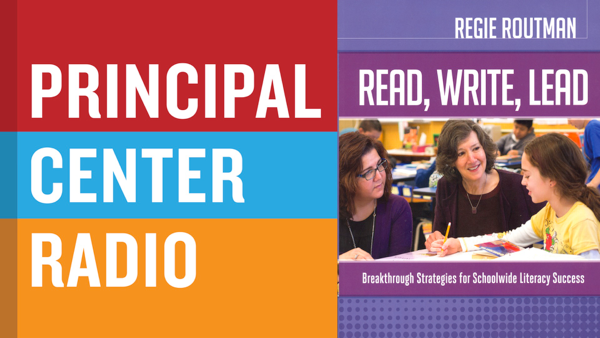
I'm your host, Justin Baeder, and I'm honored to be joined today by Riji Rautman. Riji is an international literacy expert with more than 40 years of experience teaching, coaching, and leading in diverse schools. And she's the author of more than a dozen highly respected books. And we're here today to talk about her book, Read, Write, Lead, Breakthrough Strategies for Schoolwide Literacy Success.
[00:38] Announcer:
And now, our feature presentation.
[00:40] Regie Routman:
Reggie, welcome to Principal Center Radio. Thank you, Justin.
[00:43] Justin Baeder:
I'm delighted to be here.
[00:44] Regie Routman:
I wonder if we could start by having you describe the work that you do with schools and tell us a little bit about why you wrote this book on school-wide approaches to literacy. Why do we need to have a school-wide focus on literacy?
[00:58] Regie Routman:
Okay, and maybe I should start there because that really explains the work that I do. So it has to be school-wide. I've learned that after 40 years of working in schools, primarily underperforming, high-poverty schools with large numbers of English language learners. And I found that you could always get a couple of star teachers. You could always get some teachers to do great things for some kids. But then some of those star teachers would leave or a really good principal would leave and things would fall apart, kind of like what we have in the history of school reform.
[01:32]
Just a lot of schools just treading water where nothing really changes. A new program comes in. Most schools have what I would call random acts of professional development. And so what I learned was unless it was, and this was a lot of years, I guess I'm a slow learner, but unless the professional learning, unless the teaching, the expert teaching was school-wide learning, nothing really changed that could be sustained in the way of literacy, leadership, a healthy, trusting school culture. And so all the work I do, institutes, the residency work, which I'll talk about, the focus is on the whole school. The idea of having a whole school of outstanding teachers and an outstanding principal, which is an absolute necessity.
[02:19]
And so there's kind of a guarantee that when a child moves from grade one to grade two or grade four to grade five or seven to eight, whatever, that that next teacher is going to be as good as the teacher before and that child is going to make at least a year's growth. And you know that's really not the case. That's not what happens. Now, this is hard work. And by the time I get called into a school, it's usually, well, it's almost always to raise the test scores. People are desperate.
[02:50]
The kids hate and fear, as well do the teachers, reading and writing. And what happens is that people come to see that, oh, my goodness, this work can be joyful and that it's not about finding the right program. It's about all of us working together to develop what John Hattie calls collaborative expertise, getting really smart on how we teach and how we lead. And then that makes a really huge, huge difference, right? So I wrote this book. It's an unusual audience because it's a dual audience.
[03:25]
I wrote it for teachers and teacher leaders, and I wrote it for principals. The premise of Read Write Lead is that principals have to know literacy and teachers have to be leaders. Now, that is not the case in most schools. So principals for the most part do not know literacy and so when they go into classrooms it's very difficult for them to help teachers move forward if they're not able to actually see what needs to be improved in student learning and what support teachers need and what the professional development for the school needs to be. So that's a huge focus is how do principals know literacy and For that very reason, I put together a professional development. It's not a program, but because principals don't have time to create professional development.
[04:19]
And it's on my website, Ritchie Routman in Residence. It's all available online now. I put together professional development that works, you know, sort of with professionals. any philosophy, any curriculum that a school is doing, but it's about, and it's all video based and it's all mostly high poverty schools. What does it look like and what does it sound like when we're really teaching literacy deeply across the curriculum?
[04:45] Regie Routman:
And I appreciate that point, Riji, about it being a collaborative leadership process, because I think you're absolutely right. There are a lot of principals, including myself, as a new principal, I was hired after being a middle school teacher, hired to be an elementary principal. I think there are a lot of principals who don't know literacy. And on the other hand, there are principals who seem to know everything about literacy, or at least kind of think they know everything about literacy and approach it kind of like a bull in a china shop, you know, we're going to do everything my way rather than approaching it collaboratively. And there were a few, you know, in a very large district, there were a few principals who I thought really embodied what you're talking about in terms of leading together, of embarking on this kind of school-wide process to look at the way that we teach reading and writing, the way we teach literacy. And viewing it not just as something where we need to have pockets of excellence, where we have a few teachers who are superb in what they're doing, a few teachers who go to all the conferences and lead all the professional development, but really something that is a school-wide system.
[05:50] Regie Routman:
In the work that I'm doing, there's a couple of things that are really important that I want to relate to your point. One is that the principal's job is huge. And because it's so huge, very rare for me to be in a school where principals are focusing on literacy, because there's so much else that they need to be focusing on, and nothing's ever taken away from their place or the teacher's place. So one of the things that we, and I've written about this quite extensively in Read Write Lead, is to put together a leadership team. And when I work in schools, and I'll Talk about that next. We put together a leadership team that's headed by the principal and they meet once a week and it's the really kind of the lead teachers of the school.
[06:27]
They lead the professional learning with the principal. They help set up this collaborative culture. They lead co-teaching and coaching in the schools. They have their classrooms open for other teachers. They co-teach. And so it's not just the principal who is the lead learner.
[06:48]
And obviously, the principal has the main responsibility. But as an example, in a school that I've been working with for four years in Winnipeg, where I've done probably my most successful work, I would say, we've had a writing initiative going to improve the teaching of writing in high poverty schools for seven years now. And I think part of the reason it's been so successful, and we have up to right now, we probably have maybe 75 schools involved and with more schools clamoring to get in, is that the leadership at the superintendent level is very strong. And that's unusual. And the professional development, the ongoing professional development for principals is very strong. And that's unusual.
[07:28]
And it's a very... tight collaboration that where leadership teams, not just at the school level, but at the district level, at the superintendent level are part of this. The other big thing that I've written about, and it's a whole chapter, which makes a huge difference. You mentioned about teachers going out for professional development.
[07:50]
Most of our professional development is embedded in the school, and that's what the residency model is about, that video-based professional development, which is published by Heinemann. I'll just get that in. It's on my website. But a whole chapter detailing that in the school, because that's everything. I've never seen a school increase literacy achievement and sustain it without, and I call them PLCs, but I call them, I've renamed them professional literacy communities. And the reason for that is there's been a lot of good work done in PLCs, but there's too much focus in many schools on the structure of it.
[08:27]
on the top-down nature of it, on the excess focus on data. And the focus on our PLCs is always on increasing student learning. And specifically, we're focused on how do teachers become expert teachers of reading and writing. So we're looking at videos. We're analyzing work. We are reading professional articles and books like mine and others.
[08:51]
We are trying out with support the practices, the expert practices that we're viewing and analyzing. And so that makes a huge difference. What I learned when I first started doing, which has been my major work for the last 20 years, what I call residencies and At the time, at least, I created this job. I really don't know more than one or two people across the country doing this. I created this residency model when I realized that nobody was demonstrating for teachers, and then later for principals. So a new program would be mandated, a new initiative would come in, and teachers are just supposed to like do it, you know, like there's this one day wonder workshop, right?
[09:39]
And some expert comes in, and it's like, okay, folks, get to it. And then harder than that is also what's happening now with the pressure in the Common Core State Standards and You know, the pressure to improve test scores is this fidelity to the program, this fidelity to the implementation. Well, you literally walk into some schools and district and everybody's expected to be on the same page and the learning goals are posted, whether they're worthwhile or not. Sometimes they're not. And of course, the fidelity needs to be to the student and to what the student is learning, not the program.
[10:18] Regie Routman:
Let's stop and highlight that for a second. You said rather than be so focused on fidelity of implementation of a program, we need to be more focused on fidelity to our students.
[10:29] Regie Routman:
Absolutely. And that's true for the Common Core State Standards. Look what's happening there. Well-intentioned teachers and principals are trying to implement these, okay? But if they don't have a belief system, what I call whole part, whole learning, where they're looking at these standards, the big picture of the standards...
[10:48]
Then they're trying to implement them one by one and these, you know, itty bitty pieces. And that just makes learning difficult, cumbersome, hard for kids, impossible for teachers. And in fact, I just read recently that in most places, teachers are having to create their own materials because the programs that have come out proliferated from the publishers who want to make money, first of all, are just not that good. And so, you know, what is it that we want students to learn? And I think the standards are a good idea, but they've been implemented fairly poorly in most places. No fault of the teachers or the principals.
[11:26]
It's just too difficult. You can't expect people to write their own curriculum. And also, until you have that really deep base of knowledge, you can't look at those standards and say, all right, here's what I'm going to be focusing on. And if I focus on this, then all these sub-skills, they're going to just sort of happen. If I'm focusing on what's really important, like in writing, having kids write for a real-world audience and purpose, and really valuing that reading-writing connection, noticing what authors do, having kids when they're reading, when we're reading aloud to them, noticing the craft of writing, And not just focusing on, like, okay, we need to work on punctuation and grammar, which isn't really going to do anything for helping kids become better writers. But none of that is possible until teachers and principals have a deep foundation of knowledge.
[12:19]
So our professional literacy communities start with the video-based work that I've done. Because when I work in schools, in this residency work, and these are schools all over the U.S. and Canada, they have to see what it, what it looks like. And because I can only do, you know, so many residencies a year, you know, not, not more than like, let's say five or six and still stay married to my very sweet husband and have a life. So, um, I try to balance my life.
[12:49]
And actually that's a big part of the work that I do so that I'm not traveling all the time that I'm only doing. Um, I'm only doing very few of these right now, actually. Um, The main work that I'm doing right now is going into districts and working mostly with principals and superintendents and going through classrooms and helping them, teaching them really how to go into classrooms and not just support teachers, but do the kind of professional learning that I'm talking about. But let me back up a little bit. When I first started doing these residencies about 20 years ago, because this is important, I realized that nobody was demonstrating for teachers and principals, and we talked a little bit about that. And I worked exclusively – I hadn't quite figured out yet that principal was sort of the glue that held everything together in the school.
[13:39]
Because my background was as a teacher – And I had taught, I was a reading recovery teacher, learning disabilities, but basically a teacher. I had never been an administrator and still have never been an administrator. And so what happens in the residency is I take over the classroom. And these are almost all high poverty schools. And all the teachers at the school, including the phys ed teacher, the art teacher, the music teacher, this is part of the deal, are released to watch me teach in a primary grade classroom in the morning. I'm working in K-6 schools right now primarily.
[14:12]
and an intermediate grade classroom. So if you can picture like 30 people observing, and we also have some sort of satellite schools in the district where their leadership team has come to observe. And there's maybe anywhere between, I'd say, 20 to 35, 40 people observing. And it starts off with what I call the optimal learning model, which is a big part of all of my work and a big part of my book as well, where I do the demonstration teaching. So, for instance, in Winnipeg, where we've been focusing on writing, I'm doing all the teaching and the teacher's sitting, she's right up there with me. And as the week goes by, I'm gradually releasing responsibility to the teacher.
[14:58]
So it's that I do it, we do it, we do it, you do it model. And this is in an actual classroom with real students. Right, in an actual classroom. And then we do it, let's do it together. I'm modeling the way I work with teachers exactly the way I want them to work with their kids. And then lots of time for practice, guided practice.
[15:18]
And there's a lot of conferring. And so that they get to that independent. The goal is to have... teachers, principals, students, what I call self-determining learners, and that comes from Daniel Pink's term, where they actually are self-monitoring, self-regulating, setting their own goals, so that when they go to take a test, it's not a problem.
[15:38]
They're just, you know, they do well because they actually know what they're doing. They know how to read and write, and they know how to, you know, solve their own problems when they come up. What I found was, and the residency work, because it's so intensive, it would be three to five days in a school. Everybody was thrilled at the end of the week. People were on a high. We've never had, you know, they saw their expectations started to move from, you know, very low expectations for kids to much higher expectations because I'm on site.
[16:09]
And so when the kids do well, and I insist that all the kids be in the classroom, you Sometimes they wanted to leave out the behavior problems, the special ed kids. I said, oh no, I'm not coming unless they're all there and don't tell me who they are. So everybody does well. Everybody does well. No behavior problems because the work is challenging and exciting. And that makes all the difference.
[16:29]
So we're moving at a quick pace. The kids are fascinated by the work. But what I realized was that, okay, I'm only there that one week a year and right now many of my the residencies are just three days a minimum of three days three to four days so they have to be doing that weekly professional development once i leave but that's it's pretty much all set up and the leadership team runs that because they have the the online videos so that works really well but what i failed to consider was the principle i'd come back a year later and nothing had changed when i first started doing this principal was spending most of her time or his time in the office. So for the last 15 years, I've been spending half a day with the principal. This is really, really important. This is probably the most important work that I've done in the schools, because if the principals can't
[17:23]
If the principals don't know literacy and they can't help the teachers become expert teachers of literacy, nothing really changes, and it has to be school-wide. So I spend the whole afternoon with the principal, and we do what I call instructional walks, which is my own term, and I've written extensively about that in Read, Write, Lead, so that principal... who hasn't done this could do this. This is not walk through, this is not a fly by night, you know, checking off on a digital thing, how many kids are engaged and things like that.
[17:55]
This is going into the classroom, staying for five to 20 minutes, really putting this on your calendar at least three days a week for an hour, leaving cell phones in the office. And you're a former principal, Justin, so you know this is hard to do. And just showing up and teachers know, let's say from one to two every day, you're doing instructional walks. And so the principal, and I model this the same way I model for teachers. I go in and I'm looking around that classroom and I'm looking for what's going well, what can we celebrate. And if you go on my website, which is regieroutman.org, I have a lot of articles that people could read.
[18:39]
download for free. And one of them is let's celebrate teachers before we evaluate them. And so this is a huge change for people to look at the teacher's strengths before you start commenting on the needs. And from my reading recovery training, I would say, I learned 30 years ago that if the child can only write the first letter of his first name, that's what you write down for the evaluation. The child can write the first letter of his first name. Until that time, I was, you know, the child can't do this, can't do this, can't do this.
[19:11]
So my total mindset shifted, what I just call a positive mindset. And so when I go into a classroom, I really only see... What are the strengths that this teacher has? And the teachers are really thrilled and surprised when you say, you know, I noticed that when you did this lesson today, all the kids were right with you.
[19:34]
Your pacing was terrific. And I'm writing down everything that the teacher is doing in nonjudgmental language so I can hand that to the teacher. And I'm teaching principals how to do this. And then eventually, and sometimes it's the first time, to say, you know, would you like a suggestion? I've also noticed this. Now, some people say you should talk to the students, but I would disagree with that.
[19:58]
I always talk to the teacher because if the students are doing well, it's generally because of the teacher and the way she's teaching, the way she's responding to kids. Principals have not had training, most of us as educators have not, on how to give effective feedback. productive feedback that teachers can use, that students can use. It's actually going to move learning forward in a way that's doable, comprehensible, and where people feel joyful. So this residency work and working with principals and working with teachers is joyful work, and nobody talks about joy, but it's really, really important. I would say it's one of the core principles of the work that I do.
[20:40] Regie Routman:
Wow, that's so refreshing to hear the word joy there, because I will say I have never heard feedback in joy and instructional leadership. I've never heard joy thrown into that mix. Talk to us about why joy is such a central part.
[20:55] Regie Routman:
It's very hard to be good at something that you don't like, right? But the main thing for me is joy and fear cannot coexist. And a lot of teachers are afraid to speak out. A lot of students are afraid to speak out. And this is where the culture of the school is so important that we are celebrating what people are doing well. We're celebrating the culture of the families that come to our school.
[21:16]
We're not a celebration culture. You know, here in Seattle, where I live, and just a story comes to mind, and where you live, you remember, and I'm not even a football fan, but when Seattle lost the Super Bowl a couple of years ago, in those final seconds. Do you remember that? I do. And they were expected to win. And everybody was upset.
[21:35]
Everybody was upset. And I'm like, where's the celebration? This team and this coach have worked their tails off to become the best football team in the country. And because of you know, bad luck, maybe not the best call, who knows. But there was no celebration. It was just like, you know, everybody was upset that we didn't win.
[21:57]
You know, we're a society of like, if you don't win, somehow it's not good enough. And I actually wrote a piece on that called Where's the Celebration? And so I think that is at the heart of expert literacy teaching and leading. And I don't see the joy. I had a teacher say to me some years ago, she said, you know, you came into our school and you talked about this joy thing. And I don't think you saw us roll our eyes.
[22:22]
And we're all thinking, we don't have time for this joy thing. We've got the standards, we've got to get the test scores up. But at the end of the week, we saw that that joy thing is everything. It's everything because they would say to me, you're having such a good time with our kids. And they would say, we can't remember the last time we had a good time. My feeling is the work is very difficult and it takes a full commitment and passion because we really want kids to do well and to have an equal opportunity to succeed.
[22:56]
And that is not happening in this country. And that, that, that really bothers me. Um, but when, but when the joy piece is in there, people then have, um, the energy, they have the energy to teach. And part of the joy is that you're collaborating with colleagues, that you're not just, you know, um, off by yourself in a room. And, um, somebody and that comes from creating a joyful culture where it's okay to make a mistake. Last year when I was working in Winnipeg and I think there were 45 people observing in that room.
[23:30]
There were way too many. And I think the best thing that, honestly, that observers took away from that week was I was working with a group of second and third graders, and the lesson just was not going well. And so I stopped and I said, you know what? This is not working. I'm not sure why, but the kids are not engaged, so we're going to just stop and we're going to change gears. And the teachers just, their mouths were open.
[23:53]
It's kind of like, can we do that? Can we do that? Well, they loved it. They loved it that I, you know, it was real. It's real. Not everything works.
[24:03]
And I didn't, you know, I didn't know the kids and I did, this isn't working and you know what, that's okay. This will give us more time for here. And so I just completely shifted. And that was huge for teachers that it's okay to fail. And we learned from that and it wasn't really a failure. It was just like noticing what these kids are taking in.
[24:22]
And this is what formative assessment is all about. And being able to adjust on the spot, you know, to increase student learning, you know, so all of this work is, you know, very powerful work. Now, you would think, Justin, that this would be very popular, but it's not. It's so that commitment is very rare. I would say in public schools in the US, and I can't speak for Canada, but I would say maybe three to 5% of schools are willing to to make this kind of commitment. Because it's easier just to have everybody on the same page.
[24:53]
It's easier to buy a program. And I understand that. I understand that it's really hard work to study. And you talked about the fact that you're interested in theory and I assume research. And you have to be as a teacher and as a principal. You have to be able to, you know, it's what we call seamless teaching.
[25:15]
I talk about, I've written about, I've compared my optimal learning model to the way I make a fruit tart. My husband's an artist and I'm, stuck at the stick figure stage. But in the kitchen, I'm an artist. And I've been making fruit tarts now for about 20 years. And I'm sort of famous for them among my family and friends. It's a very small group, mind you, but still.
[25:35]
And they're beautiful. And I don't use a recipe. It's very much like excellent teaching. I've had so much practice. The fruit's different every year. The amount of sugar differs.
[25:48]
And I can't use second-rate fruit and get a first-rate tart. We can't use second-rate resources, which is what we do when we buy a program, for the most part, and expect to get an outstanding result. And my process is seamless. I'm adjusting as I go along, just like in good teaching. Now, to get to that seamless stage takes years. And it takes study.
[26:11]
I'm still studying. In fact, one of the great things that I really like about Twitter, and I'm fairly new to it still, is that's where most of my professional development is coming from. It's just the research and the articles that I'm coming across every day is really quite fabulous. The frustrating part, as you know, is that it's random. But it's still pretty fascinating, and it does change the way um i'm thinking about things so so now here's what's going to happen i predict with the common core state standards and with any program that a district is using it doesn't work basically you know because people are focused on raising the test scores i had a conversation with some teachers just a couple of days ago where they told me this was very hush-hush but this has gone on all over the country that because the test scores were not very good This year they're going to be focused on the kids that almost passed but didn't.
[27:04]
And that's just terrible. And so all the kids that are – there's no chance of these kids passing. They're going into another room, literally, where there will be 30 kids. But these bubble kids, they're going to be getting extra special attention so we can pass the test. So this doesn't work. Maybe for a year.
[27:22]
And so we wind up then, you know, getting back to treading water. So the only thing that works, and I know this for sure because I'm older and 45 years of teaching and leading, is you have to have this ongoing professional learning so that – When the program is mandated in your school, you can look at it and say, okay, I can use this part, but I'm tossing out this part, and this part over here is really a waste of time. These books are just not good enough. I'm going to use our book room or real literature. But you can't do that unless you have deep professional knowledge, and that's sorely lacking here. I only see, sadly, like 3% to 5% of public schools willing to make this kind of commitment because we're in a very big hurry.
[28:10]
And one of the things that I say a lot of is that we have to slow down to hurry up. So when you get that deep base of foundational learning, which starts with having a whole school develop shared beliefs, and I spend a lot of time writing about that in Read, Write, Lead, That book, by the way, is very research-based, so there's a lot of research, and it's philosophical, but it's highly practical because I work in schools and I work in classrooms, and I know teachers and principals have to have strategies. How do we actually do that? So I talk about how to do that. Nobody talks about the fact that you have to, a district, a school, has to have all their beliefs aligned. What do we believe about reading and writing?
[28:53]
Well, if you believe that the way to teach grammar is to have kids do isolated exercises when they come into the middle school classroom, then that's what you're going to be doing. And of course, the research shows that's pretty much a waste of time. But the only way you're going to change somebody's beliefs is if they see something different. And some of that they see through the residencies and through the virtual residencies. But the beliefs have to be in alignment and they have to be in alignment with research and they have to go across the whole school. And so the reason the residency model is so important is that if the residency takes place, let's say, in a kindergarten classroom, all the teachers are there.
[29:32]
So fifth grade is looking at what's going on in kindergarten and realizing this is the same process all the way through. And how can I use what I'm seeing in this kindergarten classroom and bring it to my fifth grade classroom. It also raises expectations across the whole school because even in the high poverty schools I'm working with where they originally believed kids couldn't write in kindergarten, 90% of the kids come out of kindergarten reading. and writing, and they can write a half to a full page. And this is because of the way literacy is just woven into everything that we're doing. And teachers are astounded.
[30:09]
And so, you know, you have a fifth grade teacher looking at that, and it's like, oh my goodness, they're adding titles and exclamation marks correctly in their stories in kindergarten? You know, my kids aren't doing that in fifth grade. And so that whole school-wide conversation is absolutely critical to And it's critical for another reason. If the reading scores are terrible in grade three, it's not a blame game then. We're looking at one of the things I teach principals how to do is to look at trends when you're going into classrooms. We're looking at trends in the strengths, like classroom libraries look great.
[30:42]
Kids are excited about reading and writing. They know where to find the resources. The word walls are looking really good, but And I'm writing down, what are some of the concerns that we're seeing all over the schools? Well, the handwriting's terrible. Stuff posted in the hall, there are a lot of misspellings. The kids notice that in some classrooms that the kids are using worksheets.
[31:02]
And there's no judgment. But it's like when we get together for that professional literacy community, the principal starts out by saying, here's what I've noticed that's going great in our school. Here's some things we need to talk about that are concerns. Why is it that our reading scores are so low in third grade? What's happening in K1 and 2? So it's not a blame game.
[31:24]
It's like what the culture of the school shifts from, and this is where some of the joy comes in, from my students to our students, that everybody has ownership for what's happening in that school. And when the school becomes joyful, Justin, the parents start coming in. You know, if you're in a high poverty school, parents are they don't feel welcome in the school. You know, they're not confident. They're working two and three jobs. We haven't done sometimes a very good job reaching out to them.
[31:53]
But when they're hearing. you know, your child did pretty well today. And that might be part of that celebration culture is letting parents know, like school's just starting the first week of school, just a short note, or an email or a text. I really liked meeting your son today. Wow. I mean, we don't do that enough.
[32:14]
It doesn't take that much time. And it's that slowing down to hurry up building that relationship. And that's probably the most important thing that I model in a school. And Maybe my biggest strength is that I'm good at building relationships. I like people. I like working with teachers and principals and administrators and kids, and I see the best in them.
[32:37]
And that relationship culture is everything. You mentioned that you were a first-year principal at one time. And I would tell all new principals, focus on relationships and building trust and respect in your school. Listen, being a good listener. something I still need to work on more. And because once you have that trusting, respectful culture, anything's possible.
[33:03]
But if it's a culture of fear, nothing is possible, really. You'll just have a couple of favorite teachers that do well.
[33:09] Regie Routman:
And people who trust each other can figure out what to do. But people who don't trust each other, even if they know exactly what to do, even if they have great help, are not really going to get anywhere. So I think that's tremendous advice.
[33:21] Regie Routman:
Well, and also when you trust somebody and you have that safe culture physically and emotionally, you're not afraid to say, you know what, I really don't know how to do this. And I'm not very good at this. And could so and so come and help me with this? You just won't do it. Because you feel on the defensive. I guess it all comes back for me, you know, to the joy part.
[33:41]
And I what I tried to do and read, write, lead was make this kind of teaching and leading possible and doable and not overwhelming, because really, it is the only thing that works. because it's not a program and it's not a method. It's about collaborative expertise, which only comes from study and getting to know people well and having meaningful conversations. And then you have this conversation culture just throughout the day. Now, let me say one other thing that's really important. In the work in Winnipeg, when we started, and the writing scores, I would say, were about two years below grade level.
[34:16]
This is pretty typical everywhere in the high poverty schools. We focused initially, I focused on teachers didn't know how to teach writing. And so we focused on the basics of teaching writing. But by the third year, we moved everything to looking at the big questions. We looked at, because this is really, really important. And I'm actually working on a new book right now for Stenhouse that will be out in 2017 called Literacy Essentials, Engagement, Excellence, and Equity for All Learners.
[34:50]
And a big part of that equity piece is that All children deserve our entitled to challenging curriculum, not just our high achieving ones, not just the ones from affluent communities. And so in the work that we're doing now, where schools have been involved with this writing work for several years, the focus is on nonfiction. And so it's amazing what the kids are doing. So we're looking at what are the rights of the child, what are the rights of a human being, the right to clean water, We're looking at the endangered environment and climate change. And what does that mean? So in Winnipeg, you know, polar bears are dying out because the glaciers are melting and so having kids you know learn how to do research as early as kindergarten and asking bigger questions not just how do I get kids to revise but asking you know why is it important to study about climate change and about endangered species and what does that mean for our own environment and what can we do getting kids to become
[35:52]
agents for change in their own lives. And that's really, really important for kids that are coming from poverty, that they can make a difference in the world. So that work has been I think, really quite incredible. I'm going to be including that in my new book with some lesson plans so that people can do this and that we need to be asking bigger questions is a big part of that, not just how do I pass the test. We looked at the social studies curriculum and the science curriculum. This is how you fit it in.
[36:24]
We looked at the standards and combined them. of most of the writing then is focused in social studies and science and but it's writing for a real world audience and purpose um so in a second and third grade class and this book will be online as part of the next book a fabulous book better as good as you could find in any bookstore which then went into the public library and kids can sign it out as well as the classroom um pole bears as an endangered species and what does that mean and why is this happening and what's the research you won't believe this is written by second and third graders and this was done in collaboration with this fabulous teacher Trish Richardson I have to give her most of the credit for that because she did all of the front loading before I got there immerse the kids this is all part of that learning model immerse the kids in what's happening in our world you know and what can we do about it
[37:19] Regie Routman:
Well, Riji, it's been great to speak with you about school-wide literacy, about what we can do as leaders, and about the big picture that we need to have in mind to lead change around literacy and meet the needs of our students. And the book is Read, Write, Lead, Breakthrough Strategies for School-Wide Literacy Success. And Riji, if people want to find you online, where are some of the best places to do that?
[37:41] Regie Routman:
Well, so go to my website, RegieRoutman.org, and you can also find me on Facebook, but mostly on Twitter, at Regie Routman. And let me just mention that my book is published by ASCD, so you can look on the ASCD website for that. And I would urge you to check out articles that you can download and use for professional development and blogs that I'm writing. I do a reading blog where...
[38:07]
I talk about what I'm reading, uh, cause it's so important for teachers and leaders to be readers and it's mostly fiction, fiction and nonfiction. And so I'll be posting this week actually. Um, and I, and I have a commentary with that. So, you know, just take, take a look at that. Um, and you can contact me through my website. I do respond to all inquiries and, um, And I have greatly appreciated this opportunity, Justin, to talk with you.
[38:34] Regie Routman:
It has been a pleasure. I've learned a ton and really have enjoyed engaging with you around literacy and leadership. Thanks so much for joining me on Principal Center Radio. Thank you for having me.
[38:45] Justin Baeder:
And now, Justin Baeder on high-performance instructional leadership.
[38:50] Regie Routman:
So high-performance instructional leaders, what did you take away from my conversation with Rigi Rautman? One thing that sticks with me is the idea that this is long-term work. If I think back on the schools that I saw make the most progress, especially in literacy, especially if we're talking about K-5 or K-8 schools, that are making sustained progress over a period of years and moving from pockets of excellence, moving from having a few teachers who are amazing to really having a sustainable, systematic school-wide excellence in literacy. It took years. As we talked about in the interview, it took five, seven, 10 years in some cases to really say that they had achieved that level of sustainable excellence. So if you've been working for a while on a particular initiative, if you've been trying something, if you've adopted a new curriculum and you've been investing in professional development, I want to encourage you to stay the course.
[39:45]
I want to encourage you to stick with it and not expect overnight results because what you're doing is you're building systems and you're developing professional practice in ways that just honestly takes time. So stick with it, stay the course, don't keep changing it up, don't keep jumping to the next new thing, and you will start to see results.
[40:06] Announcer:
Thanks for listening to Principal Center Radio. For more great episodes, subscribe on our website at principalcenter.com slash radio.