Announcer (00:01):
Welcome to Principal Center Radio, helping you build capacity for instructional leadership. Here's your host, director of the Principal Center, Dr. Justin Baeder.
Justin Baeder, PhD (00:11):
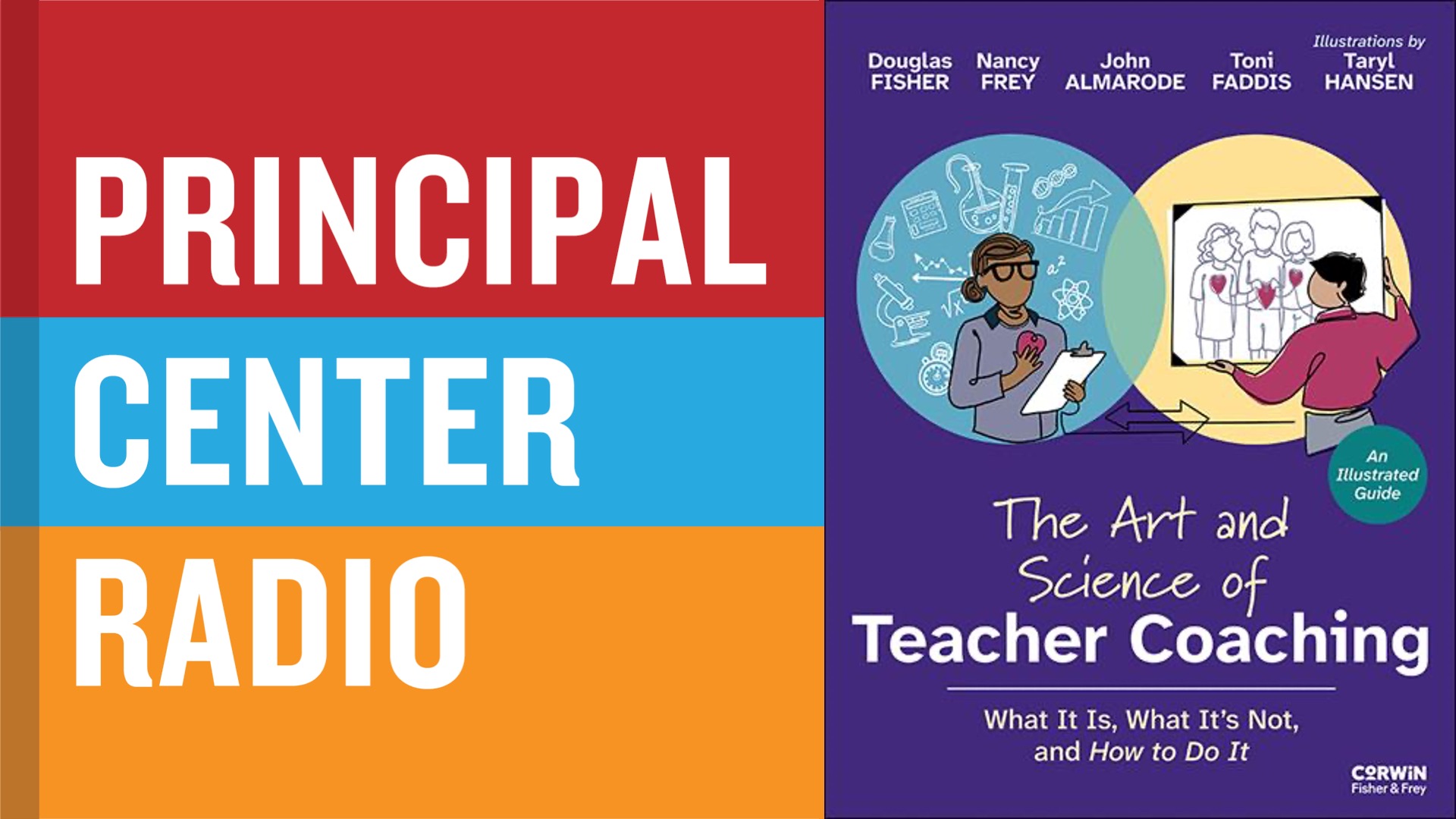
Welcome everyone to Principal Center Radio. I'm your host, Justin Baeder, and I'm honored to welcome back to the program Nancy Frey. Nancy is a professor in educational leadership at San Diego State University and a teacher leader at Health Sciences High and Middle College. She is the author of dozens of books, including The Courage to Learn, The Art and Science of Coaching, How Scaffolding Works, and the Illustrated Guide to Visible Learning, many with her longtime collaborator, Doug Fisher. And we're here today to talk about their new book, The Art and Science of Teacher Coaching. What it is, what it's not, and how to do it.
Announcer (00:47):
And now our feature presentation.
Justin Baeder, PhD (00:50):
Nancy, welcome back to Principal Center Radio.
Nancy Frey, PhD (00:52):
Well, thank you so much, Justin. I'm thrilled to be here. Thank you.
Justin Baeder, PhD (00:56):
Well, excited to talk about teacher coaching because I think over the last 10 years, it has become broadly recognized in our profession that this is something we should be doing. This is something we should be putting real effort and energy and resources into, coaching teachers, helping them to get better because the traditional approach of just letting administrators be responsible for teacher growth and not really having any other effort or though put into it just doesn't get us where we need to be. So what did you see happening in the field as far as the rise of coaching for teachers and how did that shape the book as it came together?
Nancy Frey, PhD (01:29):
Well, and I completely agree with you and I think that one of the hurdles that we've had to overcome as a profession is that when we narrowly define coaching as being something that is the responsibility of a person who has a title like instructional coach, that it narrows the number of people that can actually benefit from that. And so in many cases, that sort of traditional model of coaching is confined to either you're a brand new teacher in the field or you're a teacher that is having problems. And so there has been kind of this mindset that the only people that get coached in any way are either the newbies or you got a problem. And so it created a distance between the majority of teachers and access to coaching. And then you add into that that in some places, the only person that does the coaching is the principal and it starts to feel a whole lot like evaluation as well.
(02:31):
And so what we really wanted to do was to be able to expand and name all of the kinds of coaching that actually happen that sometimes we don't take credit for as school leaders, as expert teachers and so on, that there are a number of different conduits into the field of teaching beyond the one person who got the job of being an instructional coach.
Justin Baeder, PhD (02:56):
Well, speaking of who can be a coach or who can serve as a coach, one of the things I've observed and heard some grumbling about in recent years is the idea that an instructional coach is kind of a promotion from a teacher position for somebody who doesn't want to be an administrator. And sometimes people feel like that's not always the right way to approach it or maybe the right person is not chosen for it. How should we be thinking about finding the right people to do coaching and kind of what are the stakes there?
Nancy Frey, PhD (03:24):
And I agree with you, you're exactly right. In lots of places, an instructional coach is a step on a career ladder and often the people that traditionally get tapped into being able to do that are people who are expert teachers themselves. Just because you're an expert teacher doesn't mean that you possess the skills and the dispositions around being a coach. And there are so many opportunities within a school building to really be able to foster the kind of coaching that you want to have happen and you can better identify who that person is if in fact there's a formal position. And I think on the principal side of it, what we need to be able to do is to further articulate what does it mean when a principal is a coach versus what does it mean when you have an academic coach versus what does it mean when you are a peer coach to another colleague as well?
(04:24):
So I think there are nuances and there are shades that are in there that can help to really be able to enrich the school organization.
Justin Baeder, PhD (04:34):
Yeah. Let's come back to several issues there. One on the issue of selecting someone for a position that is called instructional coach. Certainly we want to have opportunities for our best teachers to have a greater impact. And I think that's kind of the central rationale there is, hey, you are a great teacher in your classroom. What if you could help everybody in this school become a great teacher? And what I heard you say is there is a distinct skill set. Just being a great individual practitioner doesn't automatically make you a great coach. That's why we need books, that's why we need training, that's why we need to develop expertise in coaching itself. What are some other factors that create the kind of credibility that you talk about in the book that teachers need in order to be respected as coaches taken seriously, have their work welcomed by their colleagues who maybe until recently had exactly the same job title?
(05:22):
What creates that sense of credibility?
Nancy Frey, PhD (05:24):
Right, right. Especially when you are named an instructional coach in the same building that you have been teaching in and then it's kind of like, well, how come he or she got that position and nobody offered that to me and those sorts of things. And so I think it's really useful, especially in circumstances like that to be very clear on what the job description is to be very transparent on what the job description is and that what is notable in it is not just that you know some things about teaching and learning, but also there are these particular skills that are needed. I know an increasing number of districts are having their folks kind of go through a bit of a coaching credential program. Doug and I for a number of years ran a similar kind of program in the district that we're in and our job was to be able to screen and certify applicants to any number of a variety of coaching positions and then principals would be able to interview folks from that pool as well and our coaching credentialing went beyond do you know some things about how to teach whatever grade level or content that you're in, but also too, being able to develop a coaching plan using a case study approach.
(06:50):
You've got this challenging teacher, how would you respond to all of that so that we could help to quantify what those coaching skills are and to assure others, here's why it is that that person got that particular position. They met those criteria.
Justin Baeder, PhD (07:06):
Right, right. So there's a form of recognition that it sounds like the organization can provide that training and certification can provide. Is there anything you look for in terms of that peer relationship? Because as you said, I think it always is a litle bit tricky when someone is moving from a peer into a coach relationship, which is not exactly the same and I feel like requires a degree of respect that isn't necessarily for normal peer relationships. There has to be some respect in that coaching relationship.
Nancy Frey, PhD (07:34):
Absolutely. And I think one of the qualities that I look for is, are you an active listener? And you don't have to wait until you get a particular position to suddenly become an active listener, but do you possess those kinds of skills and dispositions to do so? So watching someone in action in a grade level meeting in a professional learning community in the hallway conversations that they have with one another gives you that first inkling of, that might be somebody that I should tap into potentially moving into a more formal coaching position. And I'll say too, we have to be better at being able to create informal coaching situations and relationships so that we can build those skills and we can build that pipeline.
Justin Baeder, PhD (08:24):
What kind of situations do you have in mind that could provide those opportunities? Because I have certainly had the experience as a principal of saying, "Hey, anytime you want to do a peer observation, get into each other's classrooms, I can cover your class, we can get subs, we can do whatever." And then of course nobody ever takes you up on it. So how do you get that to happen?
Nancy Frey, PhD (08:42):
Well, one of the things that we've done at our school is we have expectations that are formal expectations, one of which is everyone is a coach and everyone is coached. And then what we build into their calendars are learning walks that happen throughout the year where teams of teachers come together and they walk each other's classrooms and they're able to give feedback. Now we've got some protocols and some guidelines for how it is that that happens. None of it is ever popping in on somebody's surprise. There's always a purpose to it. It's always scheduled and it is reciprocal. And especially when teams are more inexperienced at doing that, an administrator, one of us will go with that team in order to be able to kind of bracket those conversations. We also have some protocols, some forms for what's the information that you're collecting. You're looking for patterns and trends, you are not there evaluating individuals.
(09:41):
We talk in advance about what it means to evaluate. When you say things like, "Like the way you did, you're evaluating. You're not noticing patterns and trends along the way." So I think there are a couple of guidelines that you can put into play and quite frankly, you can structure your school schedule so that everybody gets those opportunities to do so.
Justin Baeder, PhD (10:02):
Push, there's structure, there's accountability. It's not just, "Hey, if you feel like it or if you get around to it, there really is a culture of expectation around those coaching relationships.
Nancy Frey, PhD (10:11):
Absolutely. Because you're exactly right, Justin. There are some people that are always going to take you up on that invitation to be sure, right? But there are other ways to kind of normalize what it is that that looks like. Another practice that we utilize and this one is voluntary, but we have signs that any teacher can put out on the outside of their door, their classroom door that says, This is what I'm working on right now, and they can fill it out and I welcome feedback for all of that. And there's a modeling that happens, especially when some of our more senior staff put out those signs. It helps junior staff to understand this is how things are done. This is normal.
Justin Baeder, PhD (10:57):
Yeah. To not only say, I'm open to feedback, but here's what I'm working on. Here's what you can give me feedback on. How do you approach unsolicited feedback? Because I think that's a tricky thing where sometimes people have something to say, but it's not really what someone is asking to hear in that moment.
Nancy Frey, PhD (11:16):
Right, exactly. And I mean, certainly evidence on feedback that perhaps is not only unsolicited but comes from a source that you don't have that trusting relationship with is that the feedback will be disregarded. It can be well-meaning, it can be accurate, but if you don't have that trust relationship with that person, you're going to be suspect about how it is that that happens. One of the things that we talk about is that the whole purpose of coaching is not to mold somebody else into your image. And when you start saying things like, "Well, when I was in the classroom or-"
Justin Baeder, PhD (11:53):
My old school.
Nancy Frey, PhD (11:54):
Right, right, right. Exactly. Right away, even when there's a good relationship with somebody, some of the shields go up along the way. The whole art of coaching is to be able to ask questions that help to mediate somebody else's thinking. I'm going to go cognitive coaching in this regard and then to actively listen to what their responses are, to allow them to some extent to be able to guide where that conversation is going. And that's a skill that can be taught with intention and becomes useful in pretty much any situation. It doesn't have to be a coaching situation. It can be talking with your kid while you're making dinner.
Justin Baeder, PhD (12:42):
Well, let's talk more about some of those skills because I know you have a whole section on coaching skills and you talked about establishing the relationship. What are some of the other key coaching skills?
Nancy Frey, PhD (12:52):
Yeah. We talk about in particular, as you noted, that relationship part. How do you connect? We actually think about coaching in four parts. Connect, ground, engage, and then advance because the other side of what can happen in coaching is that we never get beyond connect, right? It's a nice conversation and it doesn't actually result in anything. So connecting is certainly a part of that, but then also too, you have to ground what that conversation is going to be about. And so it is that neutral observation of whatever it was that was noticed. So thanks for letting me be in your classroom today. I really enjoyed being able to watch that. When I was in there for the time that I was in there, I noticed that there were eight different students who responded to questions you asked. That's a neutral observation. I'm not making any judgements about that whatsoever.
(13:48):
And then I follow up with that engaged part, that guiding question. What were some things that you noticed about who responded and who didn't respond? And now we can have a conversation, right? I haven't made any judgment on there weren't enough kids or you only took volunteers or anything like that at all. I want to hear what the thinking was of that teacher so that I can respond again. And it's often that exchange of those kinds of questions before you get to that last step, which is advance and that's helping them to move forward. So I heard in this conversation that you've got six or eight kids that just reliably are always responding to you. And out of this conversation, what I got is that you'd really like to see some of your quieter students begin to participate. Let's make a plan for how that's going to happen and then I want to make sure to check back in with you would next Thursday work.
(14:49):
I'll check in back with you next Thursday so we can talk about what it is that you've noticed. And now what I've done in a short period of time is I made the connection, I grounded the conversation, asked a couple of mediating questions and got that teacher to move to action. And I've got some accountability that goes with it too, which is, I need to follow up next Thursday.
Justin Baeder, PhD (15:10):
Now I want to push back on this aspect of neutrality because I feel like that often doesn't work. I want to figure out why. I feel like often when people cite evidence, the evidence itself feels loaded. I noticed that six students were off task. That's just a statement of fact, Justin. I was like, no, it's not just a statement of fact. It's like you're going somewhere with this. You're bringing this up for a reason.What's the out for the teacher if it does need to be neutral that makes it neutral? If the teacher doesn't want to talk about it or if they have a defense that says, "No, this isn't something I need to work on. " Because I feel like there is, I don't know, a value judgment in what you choose to bring up as evidence. Absolutely.
Nancy Frey, PhD (15:58):
Absolutely. And I think it's important to say too that that coaching relationship is a reciprocal one. The coach also needs to go in with the idea of like, "I should be learning from this person too." And if somebody would say to me, for example, I noticed that six kids were off task, my question would then be define off task. How was it that you decided that they were off task and now we have a different conversation. I recognize too that not every teacher is able to ask as direct of a question as I just did as well. And so at times it might even be that teacher who says, when you respond back and it says, "It sounds like you're kind of going somewhere with this. So tell me more about what it is that you're thinking about. " In other words, lob the ball back into their court and find out what's underneath all of that.
(16:53):
What are things that you're concerned about that maybe I'm not seeing or I'm not understanding? And I know sometimes when I've been in a classroom and I'm like, "This lesson is going sideways, right? Where do I even start?" And in that case, you don't want to ask the question that you asked your kids, which was, "How do you think that went?" Because what if they come back and they say, "I thought it was the best thing I ever did. Now what are you left with? "
Justin Baeder, PhD (17:27):
Well, Nancy, what do you recommend when we observe a lesson or a coach observes a lesson and things are just not going that great and we feel like, okay, I can ask an evidence-based question, but it's going to seem loaded like they're going to kind of tell where I'm going with this or like, "I just don't want this to backfire on me. " Take us into a scenario like that.
Nancy Frey, PhD (17:44):
I certainly have been in that situation before, probably on both sides of the table by the way, because don't you always feel like when you're being observed like, "Ah, that's the moment, that's the time, that's the afternoon when something unexpected happens." And there can be a temptation to start the conversation with, "Well, how do you think that went?" And as a coach, you potentially have a couple of different answers, all of which are problematic. The first answer might be, "I thought that was wonderful." Okay, what are you going to do with that? Because you didn't think it was wonderful or the person just turns into this sobbing like, "Oh my God, it was the worst thing ever," and all of those sorts of things. And now you're counselor, right? You're really not engaging in that conversation. And so I'll borrow one of my very favorite coaching questions from Bob Garmston and Art Costa, which is simply to ask, "Tell me how the lesson that you planned was different from the lesson that you taught." And now what that invites is either that teacher to be able to say, "I did this in third period and it worked really well, but when I did it in fifth period just now, I noticed and now you get to hear what their thinking is because all good teachers change up their lesson somewhat based on what it is that's going on in the classroom right now.
(19:15):
It doesn't always work, but they usually have a reason for what it is that they did. So I like being able to kind of open up a conversation when it hasn't been so great with simply asking them a question like that. I think what I would like to talk about is just kind of broadening our definition of what coaching is so that we can get more people involved informally and formally in building a coaching culture.
Justin Baeder, PhD (19:40):
Well, Nancy, you said earlier in our conversation that you have the expectation in your school that everyone is coached and everyone is a coach. I want to ask about that broad group of everyone being a coach, but I wanted to start by asking specifically about principals who are already evaluators, who already have a role that we would say is distinct from coaching. How do you get principals to wear that coaching hat or play that coaching role and what are some of the distinctions or different parameters that you put in place when someone who is also a principal is serving as a coach?
Nancy Frey, PhD (20:15):
And it can be so challenging because I think there are lots of formal evaluation systems that kind of entangle coaching with evaluation, which just sort of obscures the roles altogether. So I think one of the challenges is that in some places, coaching a full coaching cycle has been merged with an evaluation system. And so you've got the administrator who is on the one hand attempting to coach because of course we are always interested in strengthening teaching, but at the same time has evaluation processes and responsibilities as well. So first of all, I think it's really important that there's clarity around roles, that we're siloing this. These are coaching conversations versus this is part of the evaluation system. I think that is essential for both the principal as well as for the teacher to be really clear on what that is. And then to add to that, that the principal does take opportunities to actually coach and not just to do evaluation/coaching so that it normalizes, we're going to have conversations like this and this isn't a part of your evaluation.
Justin Baeder, PhD (21:36):
Yeah. Very well said. Very well said. And speaking of normalizing, it sounds like part of the purpose of normalizing it is not only so that people will be open to being on the receiving end of coaching, but will see themselves as coaches, because as you said, everyone is coached and everyone is a coach. Take us into some of what that looks like for everybody.
Nancy Frey, PhD (21:57):
Well, I think it's as much as anything, it's about establishing a school organization where there's a coaching climate. And so very often there will be the site administrator who has some coaching responsibilities and there might be an instructional coach or a district coach that has that formal title. But beyond that, what we can also look at are those opportunities for reciprocal peer coaching to happen. In other words, for teachers to be in and out of each other's rooms as well. We also talk about in the span of that, not just full cycle coaching, which typically does rest on the responsibilities of site administrators and formal instructional coaches, but also to introduce that within that coaching climate, there are two other kinds of coaching models that were utilized. One is micro coaching and the other is short cycle coaching. Now micro coaching is something that any of us can do and it's in the hallway and so on.
(23:02):
And it's essentially notice nudge. Notice something that's going on, have that short conversation and nudge that person towards some action. This is the kind of coaching that actually happens all the time between peers and nobody takes credit for it. And so I think we need to like kind of raise that up. And then this idea of some short cycle coaching and short cycle coaching is typically a week or two long. It is one goal and it is a goal that the coach and the teacher have agreed upon and they set a goal for themselves. There's a follow up for all of that as well. I'm going to be in your classroom, we're going to have a conversation, I'm going to follow up with you again. And then we flip the script and the person who was coached becomes the person who is the coach. So there's this reciprocal relationship.
(23:57):
I'm going to do some coaching of you short cycle and then you're going to do some coaching of me. And that might happen within a grade level, it might happen within a department or it might happen across grade levels or departments, but there's a level of fairness there when it is reciprocal in nature. And so I think there are opportunities there to broaden that everybody is a coach and everybody is coached because we're all engaging in these micro coaching conversations and we're all engaging in these short cycle coaching conversations
Justin Baeder, PhD (24:31):
That aspect of modeling at the leadership level that this is not something that I'm just telling you to do, but I'm actually modeling this and creating that culture of coaching. And I know in the book you have quite a few models that we probably don't have time to talk about all of them today, but you mentioned the micro coaching and the short cycle coaching. You've got lots of different cycles there and you end the book by talking about coaching as a team sport. Take us into that a little bit.
Nancy Frey, PhD (24:59):
And I think that often what is not necessarily put into place, especially for those folks that have those more formal coaching roles is that they're just confined to coaching individuals and yet those instructional coaches often have responsibility when it comes to professional learning community teams. And so being able to kind of broaden the definition of what it means to be able to coach a team because they've got responsibilities there can be really useful. I'll give one example coach being inside of a professional learning community team and perhaps the conversation is starting to drift a bit. We're admiring the problem, but not really moving anything towards action. And so that's a perfect opportunity for the coach to be able to pose a question to the team that helps the team to be able to move forward in that. At other times you might be coaching at a grade level, you might be coaching with a small group of new teachers for instance, but there are those opportunities that are there.
(26:07):
And again, we often don't call it out. We just call it other duties as prescribed, right?
Justin Baeder, PhD (26:14):
Absolutely. So the book is The Art and Science of Teacher Coaching: What It Is, What It's Not, and how to do it. Dr. Nancy Frey, if people would like to learn more about your work or get in touch with you, what can they do?
Nancy Frey, PhD (26:27):
We've got a website, www.fisherandFrey.com. Hit the contact button that will automatically go to both Doug and myself. You'll also find that we're on LinkedIn as well. We welcome any followers and we'd love to be able to follow you too.
Justin Baeder, PhD (26:45):
Wonderful. FisherinFrey.com. Well, Nancy, thank you so much for joining me again on Principal Center Radio. Always a pleasure.
Nancy Frey, PhD (26:52):
Thank you so much, Justin.
Announcer (26:57):
Thanks for listening to Principal Center Radio. For more great episodes, subscribe on our website at principalcenter.com/radio.