
Cultivate & Activate: Building Teacher Capacity for Instructional Leadership
Schools need more instructional leadership than administrators alone can provide. This book shows you how to close the four gaps preventing teachers from stepping into leadership.
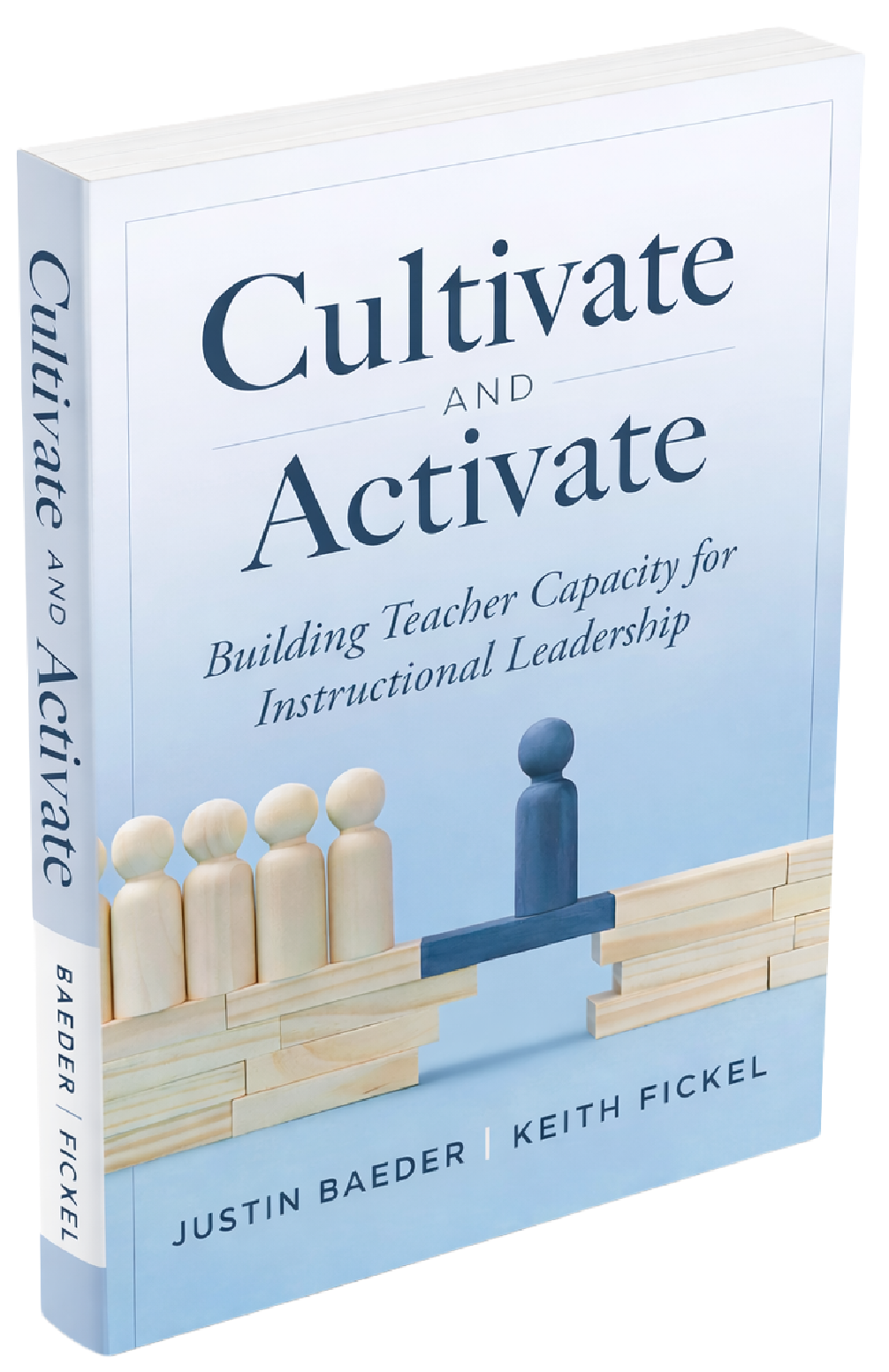
Solution Tree Press · 2026
Cultivate & Activate: Building Teacher Capacity for Instructional Leadership
By Justin Baeder and Keith Fickel
Schools need more instructional leadership than administrators alone can provide. This book shows you how to activate it.
Instructional leadership is too important — and too demanding — for any single administrator to carry alone. But most schools concentrate decision-making in too few hands, leaving teachers under-utilized and leaders overwhelmed.
Cultivate & Activate presents a practical framework for closing the four gaps that prevent teachers from stepping into leadership: the authority gap, the information gap, the opportunity gap, and the culture gap. With concrete tools, reproducible templates, and real case studies, this book shows you how to build the distributed instructional leadership your school needs.
The Four Leadership Gaps
The Authority Gap
When all decisions flow through administrators, quality and speed suffer. People closest to the work have critical information — but no authority to act on it. Closing this gap means delegating real decision-making to teachers, not just tasks.
The Information Gap
Good decisions require good information — and teachers have it. Transparent processes, decision matrices, and structured communication ensure the right people have what they need to lead effectively.
The Opportunity Gap
Teaching is an unusually flat career. Without pathways to advance, your best teachers either stagnate or leave. Associate teacher, senior teacher, and lab teacher roles create real career growth without requiring anyone to leave the classroom.
The Culture Gap
Three norms undermine teacher leadership: the teacher-administrator dichotomy, the egalitarian norm (“a teacher is a teacher”), and the expectation that leadership work should be volunteer work. Closing this gap means compensating leadership fairly and treating teacher time as an organizational expense.
What’s Inside
Introduction
Instructional leadership defined; the four gaps and how they interact; why administrators alone can’t provide enough instructional leadership for a school to thrive
- Why schools need far more instructional leadership than their administrators can possibly provide
- The four gaps that keep teacher leadership from taking hold — even in schools that say they value it
- A definition of instructional leadership that includes teachers by design, not as an afterthought
Chapter 1 — Closing the Authority Gap
The leadership bottleneck; why concentrating decisions in too few hands hurts quality and speed; tools introduced: Campus Teacher Profile, Desired Response Rubric, Standardized Interview Questions with Rubrics
- The hiring disaster that happens when the people with the best information are shut out of the decision
- Why concentrating all decisions in one person doesn’t just slow things down — it makes the decisions worse
- A structured approach to teacher-led hiring that produces better candidates and stronger buy-in
- What happens when a department chair becomes the bottleneck — and the surprisingly simple fix
Case studies: Johnson High School (teacher-led hiring); Riverview Middle School (empowering teachers to make decisions)
Chapter 2 — Closing the Information Gap
Three principles for decision-making; tools introduced: Decision Matrix with stakeholder roles (Not Applicable, Informed, Consulted, Recommendation, Final Decision), Meeting Calendar Grid, Agenda and Minutes templates
- The district leader who ignored a year of committee work — and the trust collapse that followed
- A decision-making tool that makes clear who gets informed, who gets consulted, and who gets the final call
- Three principles for making better decisions that all start with the same question: who has the information?
- Why unclear decision-making processes cause more damage than bad decisions themselves
Case study: John Dewey Elementary (rebuilding trust through transparent decision-making)
Chapter 3 — Closing the Opportunity Gap
Career flatness and the Peter Principle; alternative certification and staffing realities; tools introduced: Three-Step Responsibility Progression (Associate → Regular → Senior Teacher), Role Differentiation Model, Lab Teacher for Professional Learning, Cooperating/Mentor Teacher Roles
- What a first-year teacher and a 30-year veteran have in common that no other profession would tolerate
- The staffing structure that gives new teachers a gentler on-ramp without adding positions to the budget
- Why the best teachers keep leaving the classroom — and a role that gives them a reason to stay
- A striking statistic about new teacher certification that reveals why the traditional “sink or swim” approach is failing
Case studies: Dewey Elementary (differentiated teacher roles); Riverview Middle School (lab teacher role)
Chapter 4 — Closing the Culture Gap
Three blocking norms; the hourly rate calculation (~$60/hour based on $90K total cost / 1,500 hours); tools introduced: Stipend-Based Role Recognition, Hourly Rate Calculation, Teacher Leadership Role Flowchart, Stipend Resource Allocation Plan
- The three unwritten norms that block teacher leadership in almost every school
- Why a $500 annual stipend for department chair actually signals that the work doesn’t matter
- A straightforward calculation that reveals the true hourly cost of teacher time — and why most schools have never done it
- How one principal empowered teachers to develop the school budget and fund teacher leadership stipends
Case study: Dewey Elementary (transparent budgeting, paid leadership roles, titles with substance)
Epilogue
How the four gaps function interdependently; results: better teaching, greater morale, less turnover, greater student success; implementing with available resources
- Why closing one gap without addressing the others creates new problems
- The results schools see when all four gaps close together — for teachers, students, and the whole organization
- How schools can implement these strategies without new funding by rethinking how they allocate what they already have
Reproducible Tools Included
Related Episodes — Principal Center Radio
Explore Related Topics
Building a deep bench of teacher leaders
Trust & School CultureThe foundation for teacher leadership
HR & StaffingRecruiting, retaining, and developing staff
School ImprovementSustainable change through distributed leadership
Hard ConversationsAddressing performance and culture directly
School CommunicationTransparent processes that build trust
About the Authors
Justin Baeder, PhD
Justin Baeder, PhD is Director of The Principal Center, where he helps senior leaders in K-12 organizations build capacity for instructional leadership. A former principal in Seattle Public Schools, he is the creator of the Instructional Leadership Challenge, which has helped more than 10,000 school leaders in 50 countries around the world:
- Confidently get into classrooms every day
- Have feedback conversations that change teacher practice
- Discover their best opportunities for school improvement
Dr. Baeder directs the Instructional Leadership Association, the premiere professional membership for school leaders, and is the author of three Solution Tree books on instructional leadership:
- Now We’re Talking! 21 Days to High-Performance Instructional Leadership
- Mapping Professional Practice: How to Develop Instructional Frameworks to Support Teacher Growth (with Heather Bell-Williams)
- Cultivate and Activate: Building Teacher Capacity for Instructional Leadership (with Keith Fickel)
Justin is the host of Principal Center Radio, a long-running audio podcast featuring more than 400 education thought leaders and more than 500 books, as well as The Teaching Show and The Eduleadership Show. A prolific education commentator, he has more than 250,000 followers and 30,000,000 annual impressions on social media, and is frequently consulted by major media outlets on issues of education research, policy, and practice.
As a consultant, trainer, and speaker, Dr. Baeder has worked onsite with groups across the US, Canada, and Central America, and virtually with groups across the Middle East, Australia, and around the world. He is a frequent speaker at conferences, and regularly provides administrator professional development on classroom walkthroughs, teacher evaluation, and instructional leadership.
He holds a PhD in Educational Leadership & Policy Studies from the University of Washington and an MEd in Curriculum & Instruction from Seattle University, and is a graduate of the Danforth Program for Educational Leadership at UW.
Keith Fickel is a retired middle school and high school principal in the southwest Houston, Texas area. His focus during his decade as principal was to ensure that high levels of student learning, achievement, and personal development occurred in every classroom, every day. He accomplished these aims through the intentional empowerment of teachers and staff to effectively lead not only their classrooms but the school as a whole. Keith prioritized building and maintaining a strong bond with the school community through trust during his principalship.
He began his career in education in 1991, serving first as a classroom teacher and a band director for seventeen years, then as an assistant principal, associate principal, and campus principal during the second half of his career. His entire educational career was at the secondary level in both private and public school settings.
Keith has facilitated or cofacilitated professional learning sessions at the district, regional, and state levels on a variety of topics. He is a member of the Texas Association of Secondary School Principals and ASCD. In 2008, he was a campus Teacher of the Year, as well as a finalist for the Fort Bend ISD Secondary Teacher of the Year. In 2022, he was named the Fort Bend ISD Secondary Principal of the Year, and he had the honor of serving as the founding principal of the district’s newest high school in 2023, prior to his retirement.
Keith earned both a bachelor’s degree and a master’s degree in music education from Texas Tech University, and he completed his principal certification through the University of Houston. He resides in Sugar Land, Texas, with his wife, Anne, who was also a music teacher. Together, they have an adult daughter who is also in education.
Go Deeper With ILA
ILA members get weekly video episodes, on-demand courses, and the full Ascend career toolkit — including AI coaching to help you grow as an instructional leader.
Start Your Free Trial →