
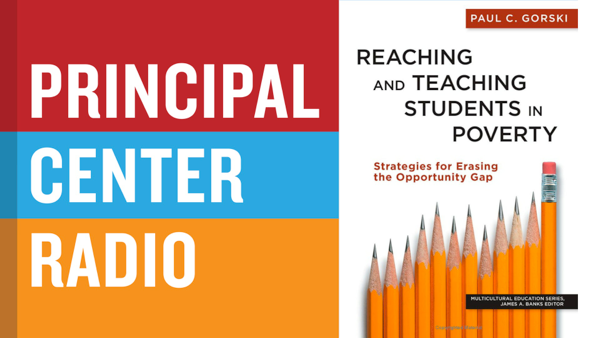
Reaching and Teaching Students in Poverty
Resources & Links
About Paul Gorski
Paul Gorski is associate professor of integrative studies at George Mason University and the founder of EdChange, an organization dedicated to educational equity.
Paul Gorski is associate professor of integrative studies at George Mason University and the founder of EdChange, an organization dedicated to educational equity.
[00:01] Justin Baeder:
Welcome to Principal Center Radio, bringing you the best in professional practice.
[00:06] Announcer:
Here's your host, director of the Principal Center and champion of high performance instructional leadership, Justin Baeder. Welcome everyone to Principal Center Radio.
[00:15] Paul Gorski:
I'm your host, Justin Baeder, and I'm thrilled that my guest today is Paul Gorski. Professor Gorski is an associate professor of integrative studies at George Mason University and the founder of EdChange, an organization dedicated to educational equity. and he is the author of numerous books. And we're here today to talk about his book, Reaching and Teaching Students in Poverty, Strategies for Erasing the Opportunity Gap.
[00:41] Announcer:
And now, our feature presentation.
[00:43] Paul Gorski:
Professor Gorski, welcome to Principal Center Radio.
[00:45] Paul Gorski:
Happy to be here, Justin. Thank you.
[00:47] Paul Gorski:
I wonder if you could tell us a little bit about what drives your research and your writing. What is it that motivates you to pursue this line of work and to work with educators around the country to promote the ideas that you've uncovered in your research to educational audiences?
[01:04] Paul Gorski:
Well, speaking specifically about the issue of poverty in education, I would say there are two major things that have driven me. The first one is, you know, my own background. My mom's side of the family is from poor Appalachian coal mining stock. And so I sort of grew up being around that part of my family, being very close to that part of my family on the one hand, and on the other hand, being sort of out in the world, hearing stereotypes, hearing rumors, you know, poor people are lazy, poor people don't care about education, poor people are bad parents, and sort of try to make sense of the, you know, the disparity between what I was hearing in society and how that didn't align with my own experience in my own family. And so I've always sort of been curious about where those stereotypes came from.
[01:59]
So if you then sort of flash forward about 25 years and being in the education world and seeing that those same sort of that work around poverty and education and initiatives around addressing what people call the achievement gap, which I actually think is really an opportunity gap, but we can talk about that later, that even in education, I was seeing that same old narrative being replayed that that the economic achievement gap exists because there's something wrong with people in poverty or there's something that we have to fix people in poverty. And I thought, you know, I thought we as educators are capable of having a much more sophisticated conversation about poverty in education. And so that's kind of what drove me to try to facilitate that conversation through the book, Reaching and Teaching Students in Poverty.
[02:55] Paul Gorski:
Great. And I think for educators, there's this sense too often that we're the victim of circumstances or external forces that we can't control. So I think just in terms of getting ourselves in the right mindset that our students' learning needs are something that we can take responsibility for, I think is a very powerful idea. And I think, as you said, for anyone who has experience, either from their background or from students they've worked with, that mindset that we see so often of kind of stereotyping people from different socioeconomic backgrounds, I think can have a pretty powerful impact on one way or the other on how we approach our work. So I wonder if you could share with us what you see as the deficits in the deficit mindset, so to speak, when we see students as having something missing when they come to us because of their background, because of their family's income, because of their family's circumstances.
[03:58]
What happens in the educational process that just makes that go badly for them throughout the school process?
[04:05] Paul Gorski:
Well, I think it starts with educators, and I'm talking about very well-intended educators, often having a deficit view of low-income students in the sense of interpreting things that are really sort of symptoms of inequalities that they've experienced their whole lives, inequalities like lack of access to health care. Lack of access to stable housing and affordable housing. Lack of access to high-quality childcare.
[04:39]
Lack of access to healthy diets. And all of these inequalities that low-income people have experienced their whole lives. And we see symptoms of those things sometimes. We see, for instance, low-income parents who don't come to school-sponsored events for family involvement at the same rates as wealthier parents. And often we interpret that as, you know, well, they don't care. You know, it's like a confirmation of my stereotype sometimes.
[05:12]
They don't care about education, and that's why they're not showing up. And so instead of understanding what's actually happening there, which is sort of these bigger inequalities that they're experiencing, for instance, if we take all working-age adults who need a job, and put them in one pile and we take all living wage jobs that are available in the world and in the country and put those in another pile. The problem is that there aren't enough living wage jobs for every working adult. So there are gonna be people in poverty, no matter how we shake it up, there are gonna be people in poverty. But instead of understanding that and understanding the impact of that on students, I think sometimes what we do is we sort of pile on the stereotypes as confirmation that they don't care.
[06:04]
And we need to be very careful not to do that. So it's all about interpretation. It's all about interpretation. And we're really good as educators at interpretation when we're looking at students and how they're learning and what they need to learn and that sort of thing. But being able to apply that, for instance, when When low-income parents don't show up to parent-teacher conferences or whatever it is, do I immediately say, aha, they're irresponsible and that sort of thing? Or do I say, well, I wonder what it would be like to not be able to afford child care and to be working a wage job so I don't have paid leave?
[06:48]
So it's hard for me to take a couple hours off or to not have transportation. I wonder what it would be like to be a parent who experienced school as a hostile environment. So do I ask myself, okay, what are the ways in which marginalized people have, you know, have been marginalized? And how can I react to that rather than kind of piling on the marginalization through the stereotypes and assumptions. And I think that gets to what you said about, now if I can do it that way, now I'm empowered to say, OK, within my sphere of influence, I might not be able to make sure all of those parents have living wage jobs. But at least I can respond in a way that's going to mitigate the effects of that and create as equitable an environment as I can create, as I have the power to create in my classroom or my school or my district.
[07:45] Paul Gorski:
So much of that comes out of our definition of of normal. You know, like if we if we think that it's normal to be able to get child care and drive yourself and your spouse to a parents only, you know, curriculum night where no kids are allowed and there's there's no dinner served and things like that, you know, if that's what we think is normal. then yeah, we're going to see a rising number of our parents kind of clashing with that definition of what it means to be a good and responsible parent. But if we're kind of more aware of what life is like for a lot of people and how we can kind of set things up so that we're providing the solution to those issues instead of just complaining that it's tough for people to come to our event or to be involved in the way we want them to be involved. I think that's a source of a huge difference for students.
[08:37]
And I wonder if we could talk about the issue of love for a second, a strange thing perhaps to talk about on Principal Center Radio. But I've heard, my wife read me a quote a while ago that she saw through some Facebook post that had been shared through many generations of shares that said something along the lines of students who are loved at home come to school to learn and students who are not loved at home come to school to be loved. And she did that thing that, you know, our spouses can do and shared it with me without really sharing what she thought. I thought about it for a minute and I said, I don't know if I agree with that or like that. Because, you know, thinking back to those kind of stereotypes of, you know, what does love look like as a parent? What does love look like toward your child?
[09:28]
when you have lots of money, and what does it look like when you don't have much at all in the way of resources? What's been your experience with that issue of love and parenting across the economic spectrum?
[09:42] Paul Gorski:
Well, and this is the deficit view, and
[09:47]
with educators or anybody who works with young people to sort of rethink a lot of these assumptions we have, especially about low-income students, students of color, low-income students of color, students with different sorts of learning differences and I think there's this big assumption that they all have these awful home lives, which is untrue. Virtually all of our students, regardless of their economic status, are getting love at home. What they're not getting has nothing to do with their parents' ability to parent or with the amount of love they're getting or about whether or not they have role models in their communities. the primary predictor of whether or not students are going to come to school ready to learn, inspired to learn, energized to learn.
[10:53]
First of all, I think virtually all students do come to school like that already. But Some of what we interpret as students not feeling that way, it has nothing to do with whether they're being loved at home. It has to do, again, with all of these other things that they've experienced. So if I come to school and my parents work multiple jobs because we're low income and so they're working evening jobs, which low income parents are, very likely to do. In fact, anyone listening to this, if you work in a school that is a high poverty school, the people who come in in the middle of the night who clean the school are probably the parents of some of the kids who are in that school. And so think about, you know, think about, if you think about it that way, so if those students come to school,
[11:45]
tired and we might think, oh, they must have irresponsible parents. Often those are kids who have parents who are responsible enough to their kids that they're working multiple jobs because that's what they need to do just to put food on the table. And then the kids are contributing by taking care care of younger siblings, helping younger siblings with homework. So it's, again, about how we interpret it. And I just think it's really dangerous to have any framework for talking about this that blames our most marginalized families for the inequalities that they've experienced, rather than
[12:30]
The fact that they're working their way through those inequalities and doing the best that they could do. So I think my job is not that kind of judgy, oh, they're not being loved at home. My job is to say, you know, they're all being loved. Everyone's being loved.
[12:50]
Not everybody, but a vast majority of our students are getting the love they need at home. And we should not be trying to predict that by socioeconomic status. When we do that, we even hurt our wealthier students because we have wealthier students who have parents who are not involved in their lives. We have wealthier students who have parents who have drug problems. We have wealthier students who are getting beaten up at home. And so it's not even good for our wealthy students to have that kind of mindset about our low-income students.
[13:22] Paul Gorski:
And I think that framing of basically of the opportunities that students have as, you know, being something that's outside of their control and something that we as educators have the opportunity and the responsibility to influence. I wonder if we might talk about that issue of what we often call the achievement gap and kind of lay complete responsibility for it on students' shoulders. But you don't call it the achievement gap, do you?
[13:50] Paul Gorski:
No, no. And again, this is sort of about the framing. Because when I look at those educational outcome disparities, whether that's things like test scores or graduation rates, And I ask myself, what's the source of those things? The source of those things, I think sometimes when we call it the achievement gap, it can be really easy to look at it through a kind of a deficit lens. And really what we're looking at there are the results or the symptoms of when we look at it across class or across race, what we're really looking at there is the symptoms of a sort of a lifetime of inequitable access. And one of the reasons why I really like talking with educators about this is because we as educators understand what that feels like.
[14:46]
Because when society isn't blaming low-income families or families of color or English language learners for those disparities, saying, well, they're not smart enough, or they're not trying hard enough, or they're not parenting well enough. What they're doing is blaming us as educators for not working what is basically a miracle. So if I'm an 11th grade language arts teacher, and I have a student who's coming in who's reading at a third grade level, or a fourth grade level, and I can't somehow miraculously get them up to grade level in one year despite all of the inequalities that they've experienced before, a lack of access to libraries in their communities, lack of access to technology, in their homes that their wealthier kids might have, lack of access to the most experienced teachers.
[15:40]
I'm getting blamed for that, right? And I might even get fired for that if not enough of my students are able to make up for that while they're my students. So we understand what it's like for people to target us with blame, despite the fact that we're working as hard as we can, despite the fact that we often are under-resourced ourselves. And so I think we have to be very careful not to then take that and then pass it down to the next most people with the least amount of power and say, okay, now we're going to blame you. So I think about it this way. Just imagine how much of that gap would disappear if all of our students had access to quality health care, if we could just give them that.
[16:33]
And if we start to think about it that way, we realize this isn't about bad parenting, and it's not about something that's inherently bad about low-income people. It's about what people have access to. What if all of our students had access to high-quality preschool? And how much of a difference would that make? What if every parent had access to one living wage job, one job 40 hours a week, and they can make enough money to feed their family and to care for their family? How much of a difference would that make?
[17:06]
So if I start looking at it through that lens, then I realize really this is an opportunity gap. It's not a gap that indicates any kind of intellectual gap. disparity, only an opportunity disparity.
[17:21] Paul Gorski:
I think that's a powerful concept, both for our view of students and for our view of our teachers. As principals, I think we often do what you just said, and that is expect miracles out of people kind of in the ninth inning. You know, if you have an 11th grader who's reading on a third grade level, you know, the problem is not your inability to help that student, you know, go up by eight or nine grade levels in one year. The problem is the system that produced that result along the way. And I think, you know, I live in the South. We live in the Ozark region of the country in northern Arkansas.
[17:59]
And there's a big attitude here that you know, that we're responsible for our own fates and everybody else is responsible for, you know, for their own fates and actions. And certainly there's a helpful side to that. You know, if you're looking for a connection between you getting out of bed in the morning and getting things done and having good results in your life, then that's helpful. But I think where that becomes unhelpful very quickly is when we start to, as you said, kind of judge other people and make assumptions about them that really are unfounded. But I think one place where we really need to look at the opportunity gap is not just for our students, but also for our teachers. And I think often it's, you know, it's about the preparation that we provided, you know, and I think about the, you know, the way that we recruit and staff, you know, we're coming up on
[18:54]
a time of year when we're thinking about who are going to be our teachers next year. And if we're not creating the opportunity for our students to get great teachers, that's an issue that we need to fix systemically and not just kind of blame whoever shows up in the same way that we tend to blame students for whatever resources they have in their lives when they come to us. So I appreciate that. that mindset quite a bit. Um, and if you could share with us, Paul, one, um, one kind of overarching strategy or one kind of mindset that we could adopt, uh, to, to kind of get us going on the right track. And I know you have a lot in the book, but, but what would you say is the biggest thing that we need to do either at the mindset level or at the strategic level to, uh, just to get more effective at, uh,
[19:47]
Shifting from that blame and achievement focus into more of an opportunity focus.
[19:54] Paul Gorski:
Well, I always say, and sometimes people don't really want to hear this, but I think that the most important shift really is an ideological shift because the ideological shift drives the practical shifts. So I think the first thing, especially for school leaders, is how do we root out of the school this notion that our low-income families are broken? And if we want to fix the test score disparities or whatever, what we need to do is fix low-income families. Because the problem with that, first of all, is that what we've known since about the mid-1970s, people have studied this. you know, tried to sort of figure out what are the differences and the ways people value education based on race, based on socioeconomic status. And what all of them found was there are no differences.
[20:44]
So low-income families value education just as much as wealthier families. The problem is, again, that we see things that we interpret as them not caring when really those are about inequalities. And like we talked earlier about, low-income family doesn't show up for some parent event at the school, and we make assumptions that they don't care when it's really they just don't have access. So part of it is about kind of just rooting that notion out and shifting to a notion, what I call what I call an equity literacy notion. So I sort of reject the culture of poverty, the cultural competence approach, which kind of puts culture at the center. I think that really drives us toward making assumptions, making deficit assumptions about different groups of people and putting equity.
[21:40]
So then the question is, how do we do all that we can do to create an equitable environment here? And that's really an ideological shift. The reason why that's so important is that even if I have a bunch of practical instructional strategies, and I do talk about a bunch of those things in the book, and I'll mention a couple here as well. Even if I have those practical instructional strategies, if I'm still coming with a deficit mindset mindset, Or even what's really popular today, which is kind of that grit mindset, which is in some ways a kind of deficit mindset. I can talk about that as well. But if I'm coming with that deficit mindset and I'm still holding on to those stereotypes that low-income parents don't care about their kids or don't care about education.
[22:30]
that low-income people are lazy or whatever, then what I'm going to be teaching is those stereotypes. If I'm a low-income student and I can see that my teacher has these biases about me and my family and they're trying to use effective strategy, what I'm going to see are the biases not the strategies. So I think the first commitment is that shift from that deficit view to what people call a structural view, which is recognizing the barriers that exist and then asking myself within my sphere of influence, what are the things, what are the ways that I can remove those barriers? It doesn't mean that I as an individual school leader or a teacher am going to be able to make sure all the families have living wage jobs. or that all the families have health care, but how can I make sure that when we're creating policy and we're creating initiatives around these things, that we're responding to the actual challenges that exist in low-income communities rather than our stereotypes about low-income people?
[23:37]
So imagine being a low-income parent. I already care desperately about my kids' education. I'm working three low-wage jobs. I understand why my child needs this education more than anybody. So I value education. I'm not able to show up at some of these events, not because I don't want to be there, but because if I miss a couple hours of wages, that has a huge impact on my family.
[24:06]
And because, to be honest, the school hasn't really thought too much about how they might structure those events to make them more accessible to somebody else. like me. And now the strategy the school has for raising test scores or whatever it is, is to try to convince me that I need to care more about my kids' education. Now you've actually further alienated your most marginalized families rather than pulling them on board. Because The problem is not that I don't care about my kids' education. The problem is that I'm in circumstances that make it impossible for me to engage the way that you're giving me the opportunity to engage.
[24:47]
And that is all about mindset and ideology of the educator. It's not... initially it's not about practical things, but if I make that shift in mindset, now I can come up with practical initiatives and strategies that are going to be much more effective. So the initiative might be, instead of trying to convince low-income parents to be more involved, might be to ask ourselves, you know, what understanding the barriers that low-income families face, what are the things that we can do to make these opportunities for family involvement more accessible.
[25:24]
Maybe we need to provide transportation. Maybe we need to do these things. Maybe we need to go into low-income communities, into a community center or some other space to make transportation easier. Maybe we need to provide childcare. Maybe we need to provide meals. What can we do?
[25:44]
Maybe we need to be more flexible on time. So that, I think, is the biggest shift. Once I make that ideological shift, that shift in understanding, now I can come up with instructional strategies that make more sense. Because they're not about fixing marginalized students. They're about fixing the things that marginalize students. And that's what we need to be doing to be most effective.
[26:08] Paul Gorski:
Well, I really appreciate that shift to focus on what's within our sphere of influence, because I think, you know, honestly, it's ironic that we place so often we place responsibility for other people's circumstances on them. And yet we engage in this kind of wishful thinking about what we want to happen in our work with students. You know, we want our students' parents to be different. We want them to have jobs that match our schedule and things like that. And there's there are example after example of things that we just wish would be different so that we could do the job that we want to do when what we really need to do is change the work that we're doing to meet the needs of the circumstance and meet the needs of our students and families. So I appreciate that.
[26:51]
So the book is Reaching and Teaching Students in Poverty. Paul, thank you so much for joining me for Principal Center Radio.
[26:59] Paul Gorski:
My pleasure, Justin. Thanks for having me.
[27:02] Justin Baeder:
And now, Justin Baeder on high-performance instructional leadership.
[27:06] Paul Gorski:
So high-performance instructional leaders, what did you take away from my interview with Professor Gorski? One thing that stands out in my mind is the structural view. And I think as educational leaders, as instructional leaders, it's our job not just to think about technique, not just to think about what we're doing in the moment, but about the systems and the structures and the processes that are creating the inputs for for what we consider our work. And not to be too structural or technical about students, but there are systems that shape the paths of students' lives and that shape the educational experience that they have prior to when they get to us. And I'm incredibly grateful for the early childhood education programs that help students get ready for kindergarten and for the middle school transition programs that help students get ready for high school and for the college prep programs that help students get ready for college.
[28:02]
I think at every level of our systems, we have to be thinking about where we're not encountering success and where what it is about our assumptions and our students that's not lining up. If we have students who need something from us that they're not getting or need something before they're getting to us, what are we going to do about that? Are we going to just kind of wring our hands and complain and say, oh, if only the elementary school did better, then it would be easier at middle school. Oh, if only this, if only that, if only the parents, if only the students. If we take responsibility as educators, not only are we engaging in more helpful thinking, we're actually going to increase our own locus of control, our own, as Professor Gorski said, our sphere of influence. We want to be able to influence the factors that affect our students' achievement.
[28:50]
You know, that's the whole idea of leadership is we want to have and influence and not just be passive victims of circumstance so i want to challenge you high performance instructional leaders to think about the structures and systems that are currently producing the results you're getting and look at not just what's happening within your current processes not just what happens within the classroom to help students who are far behind make more progress but what's happening before then and where can we make changes to ensure that students not only have good instruction, but have access to that instruction by getting the support they need early on. The more we can create opportunity and create equity, the better our results for all students are going to be, and the more of a difference we're going to make for our neediest students.
[29:41] Announcer:
Thanks for listening to Principal Center Radio. For more great episodes, subscribe on our website at principalcenter.com slash radio.
Interested in professional development, keynotes, or workshops? Send us a message below.
We'll be happy to make an introduction.